
Most Manhattan healthcare practices already have an IT provider. The question is whether that provider is actually solving problems or just closing tickets between EHR outages. When your front desk is on hold with support during a clinic morning, when a printer issue takes down check-in for forty minutes, when the same login problem hits the same provider every Monday. That’s not a healthcare IT problem. That’s a provider problem.







If you’re between 75 and 300 providers and staff, you’ve outgrown the IT Support that got you here. The signs are familiar: tickets close without the underlying issue going away, the same recurring problems hit the same workflows, and nobody can give you a straight answer about whether you’d pass a HIPAA audit tomorrow.
Practices switching to us usually have one of three problems:
 Excellent
4.8198 reviews
4.8Excellent198 reviewsPosted on Google
 Michael Hall0 days agoWheelHouse IT helped us migrate our email and files to Microsoft 365. The project was completed on schedule, and their team provided training so our employees could adjust quickly. The entire process was smoother than expected.Posted on Google
 Brent S. S. Ingraham6 days agoPosted on Google
 Emilio Martinez6 days agoWheelHouse IT has been great to us over the years! Their response time is awesome, they really know their stuff and are always ready to help. When we had a major incident they worked around the clock and got us back up and running ASAP. Really appreciate everything you guys have done for us, definitely recommend! :)Posted on Google
 Carolyn Goldberg13 days agoPosted on Google
 Syed Sarwar Hussain MD29 days agoI am thankful for wheelhouse for their help and support, making my job easierPosted on Google
 Nicole Stenger30 days agoGreat job IT! Thank you as always!Posted on Google
 Gerry Cruickshank33 days agoOur healthcare organization needed an IT provider that understood security, compliance, and the importance of keeping our systems available throughout the day. WheelHouse IT has been reliable and quick to respond whenever an issue arises. Their team communicates clearly and works efficiently to minimize interruptions to our staff and patients.Posted on Google
 Charles Douglas34 days agoWheelHouse IT helped our law firm improve its cybersecurity, Microsoft 365 environment, and data backup procedures. Their team explained everything clearly and worked around our court schedules and client meetings. We now feel much more confident that our sensitive information is properly protected.Posted on Google
 Ricky Gordon37 days agoBest Tech Support Team Ever!!! Being a client since 2018, we have enjoyed rapid responses and 100% success. Our monthly contract fee has become an essential premium assuring our stress-relieving comfort for our technological needs.Posted on Google
 Nicola Mitchell42 days agoAs a busy law firm, we cannot afford extended downtime or delays accessing client files. WheelHouse IT has been responsive, professional, and careful about keeping our systems secure. Their technicians understand the importance of confidentiality and resolve issues without disrupting our attorneys and staff.Posted on Google
 Ralph44 days agoPosted on Google
 I Murillo62 days agoPosted on Google
 Omar Taylor63 days agoPosted on Google
 N Murray63 days agoI’d like to share a review for Zoha Abdul-Mannan who assisted with our printer issue yesterday. She was incredibly knowledgeable, professional, and patient throughout the entire process. Servicing attorneys with deadlines can sometimes be demanding, but she handled everything with kindness and clear communication. Truly A+ service.Posted on Google
 D C66 days agoI am extremely grateful to Wheelhouse IT. As a small business owner, I struggled for a long time to find a comprehensive, one-stop IT solution until I found them. Wheelhouse has been the perfect fit. During our initial alignment, they vetted me as a potential client just as thoroughly as I evaluated them, ensuring that everything—from the scope of services to the pricing—was completely aligned. A company’s success truly trickles down from the top, and the owner’s strong leadership is reflected throughout the entire organization. The staff is consistently positive and genuinely seems to enjoy their work. Right out of the gate, I faced an urgent technical issue that required immediate troubleshooting. Wheelhouse IT resolved it promptly, giving me total peace of mind that my business was in good hands. In particular, Nick Barto stayed up late into the night to ensure the issue was completely resolved by the next morning. This is an outstanding company, and I highly recommend them to any business owner looking for a skilled, affordable, and reliable IT partner.Posted on Google
 Rich Gotshall78 days agoAnother trouble fixed by Wheelhouse with no issues. Do they still call them troubles? Aging my ATT side!
A lot of MSPs claim HIPAA expertise. Fewer can show you the policies, the access logs, the encryption posture, the BAA process, and the documentation trail that survives an actual audit.
We operate to HIPAA Security Rule standards across every system we manage. Staff training, regular security audits, documented incident response, and a compliance posture that holds up under scrutiny — not just on the marketing page.
If you want to know where your current setup is exposed before you switch, we run a HIPAA-focused risk assessment with no obligation attached. You leave with a written gap analysis whether or not you become a client.


You don’t switch IT providers because of one incident. You switch because of a pattern.
The pattern: the same Monday login issue every week, EHR slowness logged as resolved when the user reboots, your office manager doing first-line support because escalating takes longer than fixing it. A 30-person practice absorbs that. A 150-person practice can’t.
If two or three of those signs are familiar, your MSP hasn’t kept up with you. That’s a sizing problem on their end, not yours.
Before you switch, you should know what you’re getting. We run a 30-minute operational review with no obligation, and the point is not to pitch you.
We walk through your environment together: where your tickets concentrate, where your HIPAA posture has gaps, what your provider’s response patterns look like under load. You leave with a written summary of what we’d do differently.

The reason most practices stay with an MSP they’ve outgrown is that switching feels like it’ll be worse than staying. It usually isn’t.
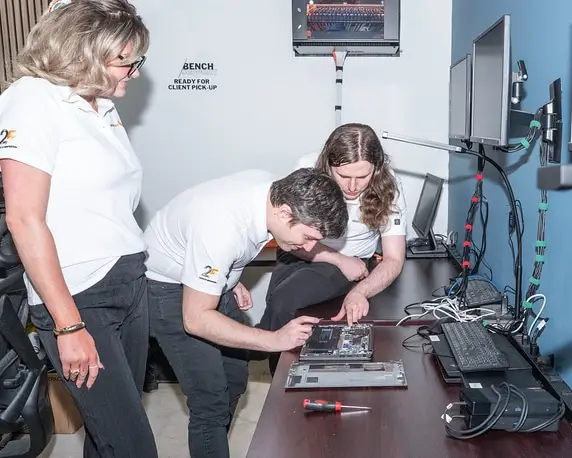
Most switches run on a structured handoff: we inventory your environment in parallel with your current provider, validate access to every system you depend on (EHR, billing, identity, backups, secure email), and stage the cutover so nothing patient-facing is at risk. Your current provider keeps the lights on until we’ve verified we can.
For a mid-sized Manhattan practice, expect four to six weeks end-to-end with zero clinical downtime as the operating standard.
Most MSPs onboard you and then go quiet until something breaks. We don’t.
The first 30 days are stabilization: documenting your environment, closing the gaps the inventory surfaced, and resolving the recurring tickets your last provider kept reopening. Days 30 to 60 are operational tuning — EHR uptime, identity hygiene, backup verification, HIPAA documentation brought current. Days 60 to 90 are the first real cadence: a written quarterly review of incidents, response times, and the operational metrics that actually matter to a practice your size.
By day 90, you should be running on fewer tickets, not more visibility into the same ones.


Most MSPs route after-hours tickets to a queue. We route them to a person.
For anything patient-facing like EHR outages, identity lockouts during clinic hours, and infrastructure incidents, our escalation is structured so an on-call engineer reaches you, not the other way around. There’s a defined severity ladder, a defined response window, and a defined human at each level. You’ll know who is working on it within minutes, not hours.
15 minutes is all it takes to see if our approach aligns with your needs.
Call, chat, email, or fill out the form to be connected with a technical advisor.