






Security often arrives as a line item on a managed services agreement. The tools get installed, the invoice goes out, and nobody is assigned to read what the tools produce.
That arrangement fails in a specific way. The controls exist and the evidence that they were running does not. So a client security review or an insurance renewal turns into a week of reconstructing history, and the alert that mattered is sitting in a log nobody opened.
WheelHouse IT runs security as a monitored service rather than installed software. The 24/7 Network Operations Center is staffed by WheelHouse IT employees and has never been outsourced. WheelHouse IT has also completed a SOC 2 examination, audited against AICPA standards by an independent CPA firm, which means an outside auditor examined the security controls WheelHouse IT runs on itself before any client asked for it.
The compliance obligation stays with your organization. It is not transferable to a vendor, and no provider can assume it. What WheelHouse IT supplies is the controls, the monitoring, and the documented evidence that both were running.

 4.8203 reviews

 Trustindex verifies that the original source of the review is Google.
 Trustindex verifies that the original source of the review is Google.
 Trustindex verifies that the original source of the review is Google.
 Trustindex verifies that the original source of the review is Google.
 Trustindex verifies that the original source of the review is Google.
 Trustindex verifies that the original source of the review is Google.
 Trustindex verifies that the original source of the review is Google.
 Trustindex verifies that the original source of the review is Google.
 Trustindex verifies that the original source of the review is Google.
 Trustindex verifies that the original source of the review is Google.
 Trustindex verifies that the original source of the review is Google.
 Trustindex verifies that the original source of the review is Google.
 Trustindex verifies that the original source of the review is Google.
 Trustindex verifies that the original source of the review is Google.
 Trustindex verifies that the original source of the review is Google.
 Trustindex verifies that the original source of the review is Google.
Four things that start a security conversation, and what keeps each one unresolved.
WheelHouse IT builds security programs from control categories rather than from a product list. Here is what the categories cover.
Security tooling produces alerts overnight and on weekends, when nobody is reading them. A Security Operations Center watches continuously and escalates what needs a human decision, which is what turns an alert into a response rather than a log entry. 24/7 SOC and SIEM monitoring.
Activity is scattered across servers, endpoints, identity, and cloud services, so nothing correlates on its own. Security information and event management collects it centrally, which is what turns a set of unremarkable events into a visible pattern.
A working password is not proof of who is using it. Multi-factor authentication and role-based access limit what a credential can reach, and close that access when someone leaves rather than when someone remembers.
You cannot close email, because the business runs on it. Filtering, sender authentication, and mailbox monitoring catch what gets through and flag the account behavior that follows a successful attempt. Email encryption.
A compromised endpoint looks normal until it does not. Managed detection and response monitors device behavior continuously and isolates a machine when that behavior changes, before the change spreads.
You cannot fix what nobody has looked for. Scheduled scanning and penetration testing find the exposures that accumulate as an environment changes, and rank them by what to address first.
A cyber liability policy is written against the control answers you give on the application. WheelHouse IT refers clients to insurance partners and works through those requirements first, so the answers are backed by evidence rather than by hope.
Security tooling produces alerts continuously. A business reads them during business hours. The gap between those two facts is where an intrusion gets the time it needs.
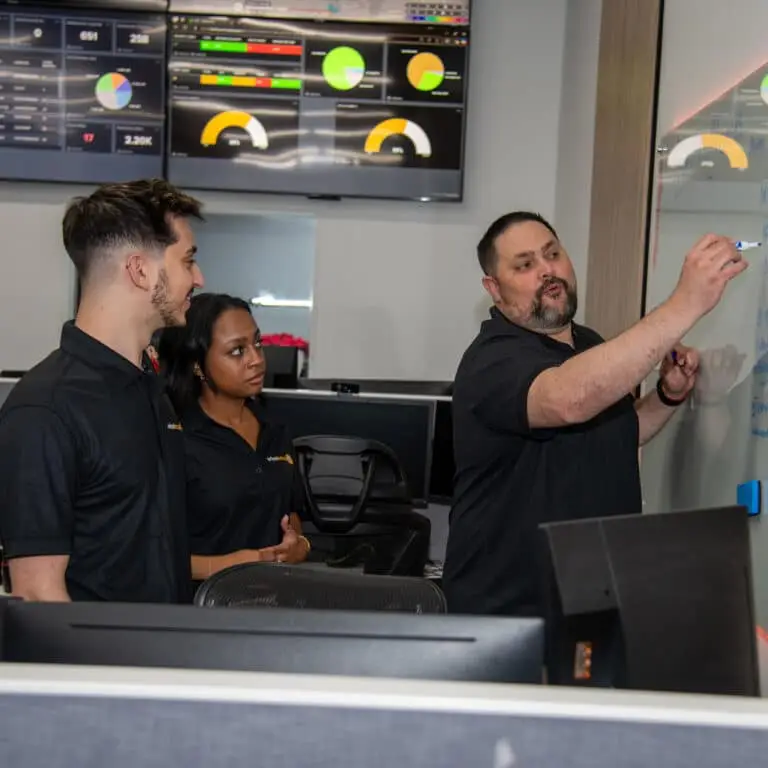
The Security Operations Center watches that gap. Security analysts monitor client environments around the clock, review what the tools surface, and escalate the events that need a human decision. The rest is closed out without waking anyone, which is the part that makes 24-hour monitoring sustainable rather than theatrical.
When something requires action, the process is isolate, restore, document. No provider can promise a recovery outcome, and one that does is describing a hope rather than a procedure. What can be committed to is the sequence and the record of it.
The Security Operations Center also produces the evidence side of the work. An auditor, an insurer, or a client running a security review does not ask whether your controls are good. They ask you to show that the controls were running on the dates in question. That is a documentation problem as much as a security one, and it is the part organizations most often have to assemble from memory.
A login from an unfamiliar location is unremarkable on its own. A run of failed logins, then a successful one, then a new mailbox rule ten minutes later is not. The difference is only visible if all three land in the same place.
Security information and event management collects activity from across the environment, including servers, endpoints, identity, and cloud services, and correlates it. That correlation is the product. Taken individually the events look like noise, and by default every one of them sits in a different log.
It also does the compliance arithmetic nobody wants to do by hand. The system gathers evidence that controls were operating and produces it as reports, which is the form an examination against the Health Insurance Portability and Accountability Act (HIPAA), the Payment Card Industry Data Security Standard (PCI-DSS), or the General Data Protection Regulation (GDPR) actually asks for. Read more about security and compliance.
A working password is not proof of who is using it. Multi-factor authentication adds a second check, so a credential on its own stops being enough to get in.
The verification method matters less than the coverage. Push approval, one-time passcodes, hardware security keys, and passwordless sign-in all work, and the right mix depends on the role. A clinical workstation shared by four people and a finance laptop that approves payments do not need the same arrangement.
The harder half of the problem starts after enrollment. Access accumulates as people change roles and is rarely reviewed back down, and accounts stay live after someone leaves because offboarding runs on recollection. WheelHouse IT ties access to the role rather than to the person, and closes it out on departure.
That is also the answer to the question every cyber insurance renewal now asks. Carriers want to know whether multi-factor authentication covers every account, including administrative accounts and remote access. Answering honestly requires knowing what the coverage actually is, which is a reporting problem before it is a security one.
Approve a sign-in from a mobile device with a single tap.
A time-limited code delivered to a phone or generated on a device.
A physical key over USB or near-field communication, using FIDO standards.
Biometric or key-based sign-in with no password in the flow at all.

It documents what you have, what is exposed, and what needs attention first. In practice that means an inventory of the systems and accounts in your environment, the gaps between the controls you are running and the ones your obligations assume, and a ranked list of what to address. It produces findings rather than a price. Pricing follows a discovery conversation and is presented in a proposal, because a number quoted before anyone has looked at your environment is a guess.
Yes, and the answer comes from documentation rather than from recollection. Insurer questionnaires and client security reviews ask for the same short list: multi-factor authentication coverage, access control, backup with tested recovery, monitoring, and a documented incident response process. WheelHouse IT supplies the controls and the evidence that they were running, which is the part most organizations cannot produce on their own. Overstating a control on a renewal form is worse than disclosing a gap, because the policy is written against the answer you gave. WheelHouse IT does not sell insurance. We refer clients to cyber liability insurance partners and work through the control requirements with you.
The process is isolate, restore, document, in that order. Isolate stops the spread. Restore brings systems back from tested backups. Document produces the record an insurer, an auditor, or your own board will ask for. No provider should promise you a recovery outcome, including this one. What we commit to is the sequence and the evidence of it.
Yes. That arrangement is co-managed IT services, and it runs as one of two programs. Comprehensive means every user reaches WheelHouse IT directly. Foundational means your internal team stays the face of IT while WheelHouse IT owns infrastructure and security behind them. Foundational is a full engagement in its own right, not a reduced tier. For an organization whose one internal IT person is absorbed by daily requests, it is the arrangement that puts that person back on the work only they can do.
WheelHouse IT has completed a SOC 2 examination, audited against AICPA standards by an independent CPA firm. That means an outside auditor examined the security controls WheelHouse IT runs internally, not the ones described in a brochure. CISSP-certified engineers are on staff, staff are verified as HIPAA compliant through an independent third party, and WheelHouse IT holds the HIPAA Seal of Compliance from Compliancy Group.
We describe our controls by category rather than by vendor: managed detection and response on endpoints, network monitoring, email filtering and authentication, identity and access management, vulnerability scanning, and backup with tested recovery. We do not publish the specific products. Naming them helps competitors position against the stack and helps an attacker profile the environments we protect. The specifics are part of the discovery conversation.
More questions are answered on our FAQ page.
If a client security addendum is sitting unanswered, or a renewal questionnaire asks something nobody in the building can answer, or you cannot say who has access to what, that is the point at which this becomes worth a conversation.
If you want something concrete before that conversation, the free network risk assessment documents what you have, what is exposed, and what needs attention first. It produces findings, not a price. Pricing follows discovery and is presented in a proposal.
Fifteen minutes is enough to find out whether this is a fit. Florida (954) 474-2204, New York (516) 536-5006.

15 minutes is all it takes to see if our approach aligns with your needs.
Call, chat, email, or fill out the form to be connected with a technical advisor.