
Most Miami businesses already have security tooling. The question is whether anyone is watching it or just renewing the license.
If nobody can say when a restore was last tested, the last vulnerability scan predates your current firewall, or alerts land in a mailbox nobody owns, that is not a security problem. That is a provider problem.







Endpoint detection, managed response, identity controls, and backup validation are operated by the same team every day rather than licensed and forgotten. That is the difference between a security stack that exists and one that is run. Ask your current provider which of those four they actually operate.
Security monitoring runs through our own analysts, not a white-labeled vendor you never meet. The team is South Florida based, with monitoring in our own US network operations centers, never outsourced overseas. When an alert fires at 2am it reaches a person with the context to decide whether it matters, and your named pod is the group that calls you about it.
In Miami-Dade, resilience also means hurricane season. Attackers do not pause for a landfall, and a week of generators and degraded connectivity is exactly when controls slip and staff start working around them. Pre-season readiness reviews confirm that backups are current and restorable, that failover connectivity holds, and that remote access and MFA still work when the office does not.

 4.8202 reviews

 Trustindex verifies that the original source of the review is Google.
 Trustindex verifies that the original source of the review is Google.
 Trustindex verifies that the original source of the review is Google.
 Trustindex verifies that the original source of the review is Google.
 Trustindex verifies that the original source of the review is Google.
 Trustindex verifies that the original source of the review is Google.
 Trustindex verifies that the original source of the review is Google.
 Trustindex verifies that the original source of the review is Google.
 Trustindex verifies that the original source of the review is Google.
 Trustindex verifies that the original source of the review is Google.
 Trustindex verifies that the original source of the review is Google.
 Trustindex verifies that the original source of the review is Google.
 Trustindex verifies that the original source of the review is Google.
 Trustindex verifies that the original source of the review is Google.
 Trustindex verifies that the original source of the review is Google.
 Trustindex verifies that the original source of the review is Google.
Almost every Miami client who moved their security to us described one of the six situations below. In most cases nothing had gone wrong yet, which is precisely why the gap had survived so long. A control nobody tests and an alert nobody reads look identical to working security, right up until the morning they do not.
Antivirus and a firewall were a security program once. Today they are two controls in a stack that needs endpoint detection and response, managed detection and response, identity hardening, vulnerability scanning, and someone monitoring all of it. If your provider cannot draw you the layers, you do not have layers.
Business email compromise does not trip antivirus, because nothing malicious is attached. It relies on a plausible message, a busy controller, and no verification step. In a market where international wires, real estate closings, and vendor deposits move daily, that is the attack that actually lands. Email authentication, impersonation protection, and trained staff are what stop it.
Carriers now want evidence of MFA coverage, EDR deployment, backup testing, and privileged access controls. So do HIPAA, PCI DSS, and SOC 2 auditors, and so do the enterprise clients running vendor security reviews on you. Answering from memory is how coverage gets priced up, excluded, or declined.
Detection without response is a logging exercise. The question is not whether you have monitoring. It is whether a named analyst triaged that alert, what they concluded, how long it took, and where that decision is written down. If the answer is a monthly PDF, you have a report, not a response.
A backup that has never been restored is not a backup. It is a job that reports success. Ransomware recovery is where that distinction gets discovered, usually alongside the discovery that the backups were reachable with the same credentials the attacker used. Restores should be tested on a schedule, with a recovery time you can state out loud.
Home routers, hotel Wi-Fi, a second office across the county, a job site with a hotspot: all of it sits outside whatever was built for the office perimeter. Coverage has to follow the user, through device management, conditional access, and DNS filtering that applies wherever the laptop happens to be.
Not all providers are built the same, and most sell a stack they do not operate. Here is how our structure addresses the gaps that bring companies to us.
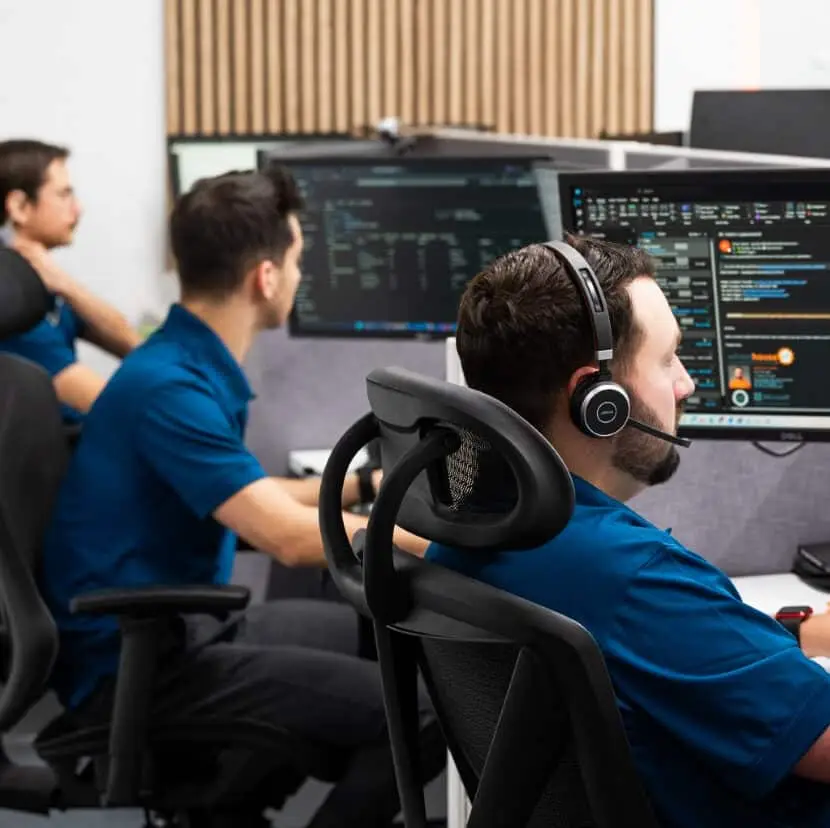
CrowdStrike EDR on the endpoint and Huntress for managed detection and response, backed by 24/7 SOC coverage and Tenable vulnerability scanning. SOC 2 examined, which means our own controls across access, monitoring, and incident response were examined by a third-party auditor rather than described in a brochure. Annual penetration testing, with continuous scanning in between.
Security monitoring is not white-labeled to a third party and not outsourced overseas. Alerts are triaged by our analysts, who can see your environment and reach your pod directly. That is the difference between an alert being escalated and an alert being forwarded.
Your dedicated pod includes technicians and an account manager who know your environment and your people. During an incident that matters more than at any other time, because nobody is learning your network while the clock runs. Your pod picks up in about 52 seconds.
Month-to-month programs are available for qualified new clients. With nothing locking you in, the work has to justify itself every month, which is a healthier arrangement than a three-year term and an annual review.
Stay compliant with industry-specific regulations like HIPAA, FINRA, GDPR, and more with our specialized compliance solutions.
Use AI-driven analytics from our dashboard platform to optimize IT resources, predict downtime, and enhance learning experiences. Automated insights help educators focus on students, not servers.
Support for industry-specific applications and integration with specialized software platforms your business relies on.
Security is sold in acronyms and delivered in configuration. This is the coverage a mid-sized company in Miami-Dade should expect, and what we operate under one flat monthly fee.
Endpoint and detection. CrowdStrike EDR across workstations and servers, with Huntress managed detection and response layered over it. Behavioral analysis catches the lateral movement and credential misuse that signature-based tools miss. A 24/7 SOC triages what fires, and a person decides what happens next.
Email and identity. Email authentication, impersonation and phishing protection, and encryption where the content requires it. On the identity side, MFA enforcement, conditional access policy, privileged access review, and offboarding that removes access on the day someone leaves. Ongoing end-user security training, because the controller who pauses on a changed wire instruction is a control.
Network and access. Firewall as a service: next-generation firewall configuration and management with the hardware refresh and rule reviews included. Network segmentation so one compromised endpoint does not reach everything, DNS filtering that blocks malicious domains before a connection opens, and VPN and remote access controls that extend the same posture to home offices and job sites.
Backup and recovery. Backup with tested restores on a schedule and defined recovery time objectives, so you know how long recovery takes before you need to know. Disaster Recovery as a Service restores critical systems against a defined recovery objective for the workloads that cannot wait.
Testing and validation. Annual penetration testing, continuous Tenable vulnerability scanning between assessments, and gap assessments mapped to HIPAA, PCI DSS, SOC 2, FINRA, GDPR, and Florida’s data protection statutes. We monitor for control drift rather than checking once a year.
Incident response. If something does get through, containment, investigation, and post-incident remediation that closes the gap that allowed it. Documentation your carrier, your auditor, and your enterprise clients will ask for.

Most companies do not change security providers after a breach. They change when they realize they could not describe their own coverage in a meeting. We have run this transition many times, and most clients are fully cut over in 30 days or less, with the environment documented from day one.
You get documented controls, tested restores, and penetration test findings with a remediation roadmap. When your carrier or your largest client asks, the answer already exists in writing.
Managed detection and response, firewall as a service, endpoint protection, vulnerability scanning, and disaster recovery are included in the service rather than sold as tiers you discover you are missing. No incident-time negotiation about what is covered.
Your pod picks up in about 52 seconds and resolves most tickets in 29.6 minutes. During an incident you are talking to people who already know how your environment is built.
Penetration testing annually, vulnerability scanning continuously, restores validated on a schedule. The controls get checked whether or not anything has gone wrong.



15 minutes is all it takes to see if our approach aligns with your needs.
Call, chat, email, or fill out the form to be connected with a technical advisor.