Have you been avoiding starting a Pay Per Click ad campaign with Google Ads, or do you currently run ads with lackluster results? It’s common for businesses to be afraid to risk what could basically be seen as “setting their money on fire” by investing in potentially ineffective ads. It’s also understandable to be reluctant to put effort towards improving your online visibility completely organically. But something’s gotta give, right? Below we’ll explore the pros and cons of PPC vs SEO and which is ultimately better for your business’s advertising.
What Is Pay Per Click (PPC)?
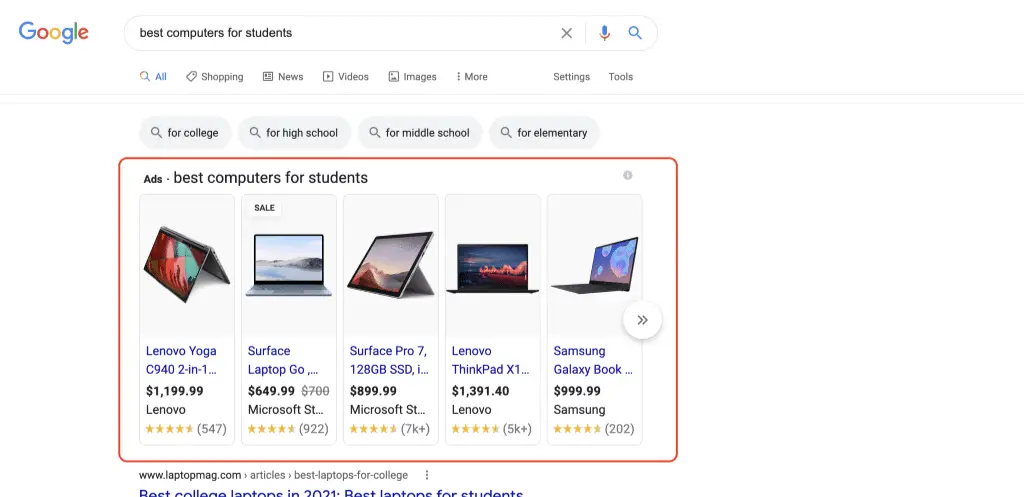
Semrush describes PPC as an online advertising model where advertisers run ads on a platform such as Google Ads and pay a fee every time someone clicks on it.
Below are a couple of examples of what this usually looks like.
Basically, most results on Google that have an “Ads” or “Ad” sign next to their listing.
Pros of PPC
Precise targeting
Ability to track results
Immediate visibility — since you’re putting money behind these campaigns, once you implement it, you’ll start seeing traffic almost immediately
Cons of PPC
Costly — you pay for each click, and the fight for the top result can turn into a bidding war
People barely click on Google Ads — less than 10% of people actually click on paid ads on Google
The cost of PPC is increasing — since Google has grown in popularity for both searchers and advertisers
Benefits won’t improve over time — you’ll only see better results the more money you spend on campaigns
What Is Organic SEO?
Search Engine Optimization (SEO) is best described as a way of improving your online visibility and website reach on search engines through organic or unpaid means. These efforts are executed by strategically using keywords, link placements (a.k.a. backlinks), images, metadata, and more in order to increase link authority on a page or pages — with the goal of increasing your business’s ranking on search engines. In other words, getting your website to the top of Google’s search results organically.
Below is an example of what organic search results look like.
Basically, results on Google that don’t have an “Ads” or “Ad” sign next to their listing.
Pros of SEO
It’s free!
Opportunity to re-strategize whenever
Offers a continuous flow of targeted traffic
High conversion rates — Search Engine Journal reports that leads generated by SEO can reach a 14.6% close rate, compared to just 1.7% from email marketing or print advertising
Risk of being penalized — you need to stay aware of search engine algorithm updates and requirement changes
Verdict
No one method is perfect for improving your business’s online visibility. However, in terms of cost effectiveness and overall reach, we strongly believe SEO is the best route. With its low cost and organic ability to reach the individual rather than the machine, it’s a no brainer.
Stop setting your money on fire with Pay Per Click and choose to amplify your online presence organically by ranking on major search engines. Page rankings can be very competitive, but with our proven SEO strategy we can help your website rise through the ranks. Our SEO strategy involves: