Most Orlando companies your size already have some form of internal IT team.
If your people are buried in patching, password resets, and after-hours alerts while the strategic projects keep slipping, that is not a staffing problem. It is a coverage problem. Co-managed IT should absorb the load your team does not have time for, not add another layer to coordinate.







WheelHouse IT runs a staffed office in Orlando, at Alafaya Corporate Center on N Alafaya Trail, so the people supporting your business are local rather than a queue routed across the country. You work with a dedicated pod that knows your environment and your account, and you reach a familiar team that already understands your setup instead of re-explaining the problem every time.
Co-managed IT is augmentation, not a takeover. Your internal team keeps ownership of the systems and decisions they want to own, and we cover the tactical load underneath them: monitoring, patching, escalations, and the day-to-day ticket volume that pulls your staff off higher-value work. Nothing gets displaced, and your team stops being the bottleneck.
 Excellent
4.8199 reviews
4.8Excellent199 reviewsPosted on Google
 darcel gray10 days agoOmg the food is so flavored I had lasagna.Posted on Google
 Alex Cruz10 days agoWe had an urgent server issue that prevented several employees from working. WheelHouse IT responded immediately and had us operational again much faster than anticipated. Their communication during the incident was excellent.Posted on Google
 Brent S. S. Ingraham19 days agoPosted on Google
 Emilio Martinez19 days agoWheelHouse IT has been great to us over the years! Their response time is awesome, they really know their stuff and are always ready to help. When we had a major incident they worked around the clock and got us back up and running ASAP. Really appreciate everything you guys have done for us, definitely recommend! :)Posted on Google
 Carolyn Goldberg25 days agoPosted on Google
 Syed Sarwar Hussain MD42 days agoI am thankful for wheelhouse for their help and support, making my job easierPosted on Google
 Nicole Stenger43 days agoGreat job IT! Thank you as always!Posted on Google
 Gerry Cruickshank46 days agoOur healthcare organization needed an IT provider that understood security, compliance, and the importance of keeping our systems available throughout the day. WheelHouse IT has been reliable and quick to respond whenever an issue arises. Their team communicates clearly and works efficiently to minimize interruptions to our staff and patients.Posted on Google
 Charles Douglas47 days agoWheelHouse IT helped our law firm improve its cybersecurity, Microsoft 365 environment, and data backup procedures. Their team explained everything clearly and worked around our court schedules and client meetings. We now feel much more confident that our sensitive information is properly protected.Posted on Google
 Ricky Gordon50 days agoBest Tech Support Team Ever!!! Being a client since 2018, we have enjoyed rapid responses and 100% success. Our monthly contract fee has become an essential premium assuring our stress-relieving comfort for our technological needs.Posted on Google
 Nicola Mitchell55 days agoAs a busy law firm, we cannot afford extended downtime or delays accessing client files. WheelHouse IT has been responsive, professional, and careful about keeping our systems secure. Their technicians understand the importance of confidentiality and resolve issues without disrupting our attorneys and staff.Posted on Google
 Ralph57 days agoPosted on Google
 I Murillo75 days agoPosted on Google
 Omar Taylor76 days agoPosted on Google
 N Murray76 days agoI’d like to share a review for Zoha Abdul-Mannan who assisted with our printer issue yesterday. She was incredibly knowledgeable, professional, and patient throughout the entire process. Servicing attorneys with deadlines can sometimes be demanding, but she handled everything with kindness and clear communication. Truly A+ service.Posted on Google
 D C79 days agoI am extremely grateful to Wheelhouse IT. As a small business owner, I struggled for a long time to find a comprehensive, one-stop IT solution until I found them. Wheelhouse has been the perfect fit. During our initial alignment, they vetted me as a potential client just as thoroughly as I evaluated them, ensuring that everything—from the scope of services to the pricing—was completely aligned. A company’s success truly trickles down from the top, and the owner’s strong leadership is reflected throughout the entire organization. The staff is consistently positive and genuinely seems to enjoy their work. Right out of the gate, I faced an urgent technical issue that required immediate troubleshooting. Wheelhouse IT resolved it promptly, giving me total peace of mind that my business was in good hands. In particular, Nick Barto stayed up late into the night to ensure the issue was completely resolved by the next morning. This is an outstanding company, and I highly recommend them to any business owner looking for a skilled, affordable, and reliable IT partner.
Most companies that bring us in as a co-managed partner described one of these six situations first. None of them is a reflection of the internal team. They are the predictable result of a lean staff covering more ground than any group that size can cover, with no outside help absorbing the routine load. Here is what that looks like day to day.
Every strategic project competes with the help-desk queue, and the queue usually wins. Skilled people spend their week on password resets and printer tickets instead of the roadmap work you hired them for. A co-managed pod takes the routine volume off their desk so your staff can do the work only they can do.
A small internal team cannot watch systems around the clock without burning out. Issues that surface at 2 a.m. sit untouched until someone logs in, and by then a minor alert has become a morning outage. Our internal US-based NOC monitors continuously, so overnight problems get caught while your team sleeps.
When patching and hardware refreshes depend on whoever has a free hour, they fall behind, and the backlog becomes a security and reliability risk no one chooses. We run patching and lifecycle planning on a schedule, so updates happen on time and aging hardware gets replaced on a plan instead of after it fails.
Monitoring in one place, ticketing in another, security somewhere else, and no one with the hours to tie it together. The gaps between tools are where things slip. We bring a standardized stack for monitoring, detection, and management, and your team gets one consistent operating picture instead of a patchwork.
Every new hire, departure, and license change is manual work that lands on the same overloaded people, and offboarding gaps quietly become access risks. We handle Microsoft 365 user lifecycle and licensing support, so provisioning and deprovisioning happen cleanly and your team is not the bottleneck on day one or last day.
When the CFO or operations lead asks what IT spend is buying or where the risk sits, the answer takes a week your team does not have. We deliver advanced reporting and analytics so the visibility leadership wants is already there, without pulling an engineer off real work to assemble it.
Not all co-managed arrangements are built the same. Many add coordination overhead without taking real work away. Here is how WheelHouse IT’s structure is built to fill the gaps that cause most internal teams to look for help in the first place.
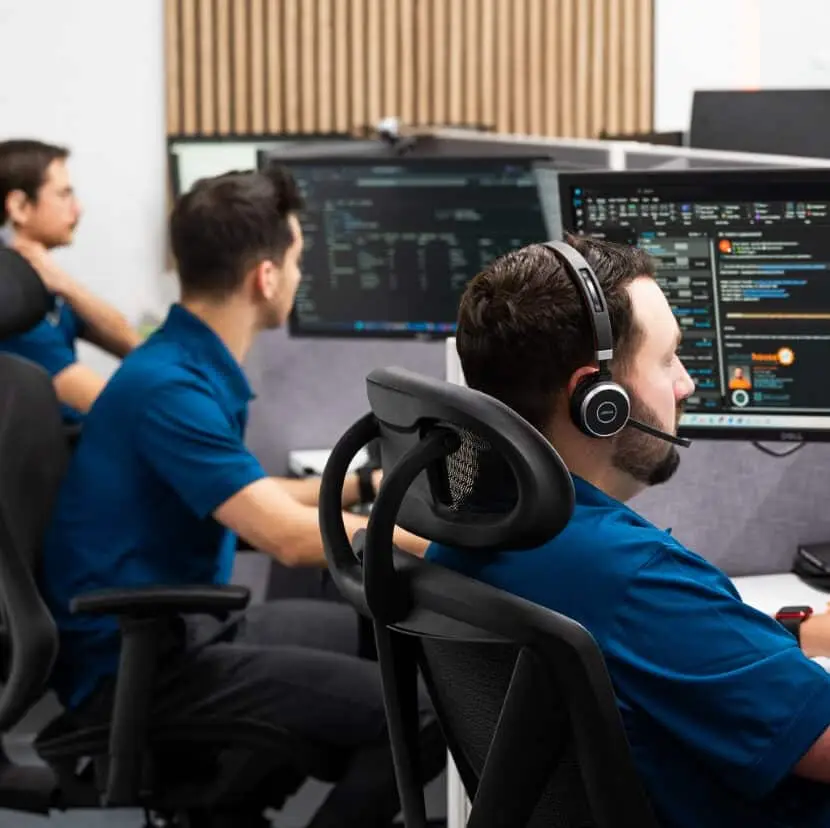
You get a dedicated pod of technicians and an account manager who learn your environment and work alongside your staff. Your team keeps ownership of what matters to them; the pod absorbs the load underneath. You are never re-explaining your setup to a stranger.
Monitoring is run by our own team in the United States, not outsourced overseas. That is what makes around-the-clock coverage real rather than a line on a contract, and it is the difference between catching an overnight issue and inheriting it at 8 a.m.
SOC 2 controls, CrowdStrike for endpoint detection and response, and Huntress for managed detection and response, backed by annual penetration testing and continuous vulnerability scanning. Your internal team gets enterprise tooling without sourcing, licensing, and managing it themselves.
Month-to-month programs are available for qualified clients. With no contract locking you in, the partnership has to earn its place every month, and that changes how every ticket and escalation gets handled.
Support for HIPAA, PCI, GDPR, and other framework requirements, with documented controls and audit-ready reporting your internal team does not have to assemble from scratch.
Support for the industry-specific and line-of-business applications your operations depend on, including integration with the platforms your team already runs.
Operational dashboards that surface system health, capacity, and risk, so your team and your leadership can see what is coming instead of reacting after the fact.
A lean IT team rarely has the hours to run a full security program on top of daily support. We layer it underneath them: SOC 2 controls, CrowdStrike endpoint detection, Huntress managed detection and response, annual penetration testing, and continuous vulnerability scanning between assessments. Backups are validated on a schedule, because a backup that has never been restored is not a backup. Your team keeps oversight; the continuous work runs in the background.
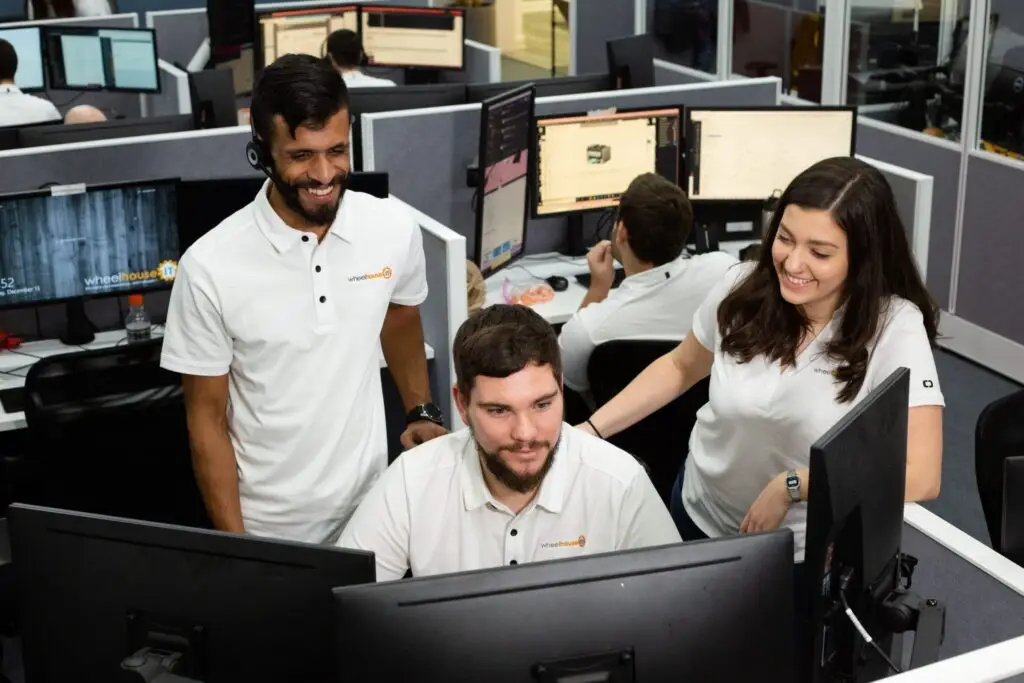
Bringing in a co-managed partner should reduce work, not create a transition project. We handle the handoff and document the environment from day one, so your team feels the load lighten quickly instead of spending months onboarding.
Routine tickets, monitoring, and after-hours coverage move to us, so your staff gets their week back for the projects that move the business.
An internal US-based NOC watches your systems around the clock, so nothing waits until someone logs in.
Flat monthly pricing means your finance team can plan IT spend without surprise invoices or hourly billing.
Month-to-month terms mean the partnership earns its place every month, and you stay in control of the relationship.
15 minutes is all it takes to see if our approach aligns with your needs.
Call, chat, email, or fill out the form to be connected with a technical advisor.